M&A Monday: Average EBITDA Multiples for 10 Key Industries in 2026


Happy Monday. If you’re reading this, you’ve probably spent a few late nights staring at your P&L, wondering what all that hard work is actually worth in the open market.
Over the last eight years as a business broker and after performing over 100 valuations, I’ve realized one thing: most business owners are flying blind. They see a headline about a tech startup selling for 20x revenue and think their local manufacturing plant should command the same.
Today, I’m pulling back the curtain. We’re looking at the actual EBITDA multiples for 10 key industries based on 2025 and 2026 trends. But before we dive into the numbers, we need to have a "real talk" moment about the gap between what you see on the news and what actually happens on the shop floor.
The "Public vs. Private" Reality Check
One of the biggest hurdles I face when talking to owners like Mark, a guy who has run a successful HVAC company for twenty years, is the "Public Gap."
If you look at data from NYU Stern / Damodaran, you’ll see massive multiples. Publicly traded companies often trade at 10x, 15x, or even 25x EBITDA. Why? Because they are liquid. An investor can sell their shares in two seconds with a click of a button.
Your private business? Not so much. It’s an "illiquid asset." It takes months to sell, involves massive due diligence, and carries more risk. For most small to mid-sized businesses (SMBs), the reality is a multiple between 3x and 5x.
If you’re doing $500k to $2M in EBITDA, you aren't trading at Nvidia prices. And that’s okay, as long as you know the rules of the game you’re playing.

10 Key Industry Multiples for 2025-2026
The following ranges represent where we are seeing deals close in the current 2025-2026 market for private companies. These are based on data trends from sources like Equidam, First Page Sage, and Raincatcher.
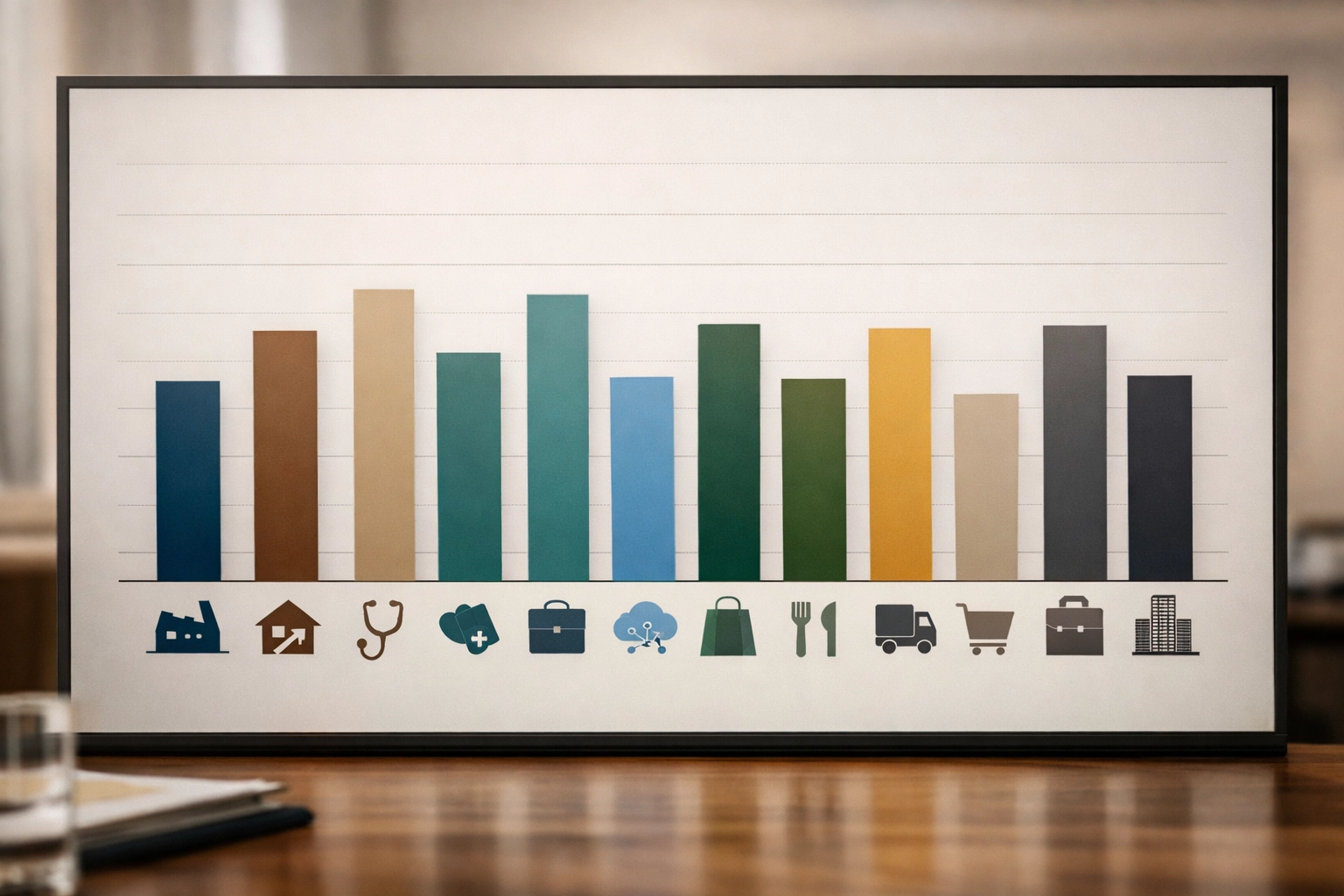
1. Manufacturing (4.0x – 5.5x)
Manufacturing remains a staple, especially as "near-shoring" continues to grow in 2026. I’ve spent plenty of time on shop floors, and I can tell you: buyers love "boring" businesses with heavy equipment and long-term contracts. A machine shop with modern CNC equipment and a diverse client base will hit the higher end of this range. If your equipment is from the 80s and 80% of your revenue comes from one client, expect to be on the lower end.
2. Construction & Trades (3.0x – 4.5x)
Think plumbing, HVAC, and electrical. These are high-demand but often penalized because they are "owner-heavy." If the owner is the only one who knows how to bid a job, the value drops. However, service-based recurring maintenance contracts are gold right now. A plumbing company with 2,000 "membership" clients is worth way more than one that just chases emergency calls.
3. Healthcare (4.5x – 7.0x)
This includes private practices, urgent care, and home health. Healthcare consistently commands higher multiples because of the "graying of America" and steady demand. However, regulatory complexity and insurance reimbursement risks keep these from hitting tech-level multiples. Specialized clinics often see the 6x+ range.
4. Professional Services (3.5x – 5.0x)
Engineering firms, architecture practices, and accounting firms fall here. The biggest risk? "The Owner Trap." If the clients are only there because they like you, a buyer isn't buying a business, they’re buying a job. To get a 5x multiple, you need a leadership team that doesn't include you.
5. Technology & SaaS (5.0x – 8.0x+)
While the "growth at all costs" era of 2021 is over, profitable tech is still king. For private software companies with high retention and low churn, 6x to 8x EBITDA is common. If you’re a pure SaaS play with 90% recurring revenue, you’re the outlier that can still push toward double digits.
6. Retail (2.5x – 4.0x)
Retail is tough. Between e-commerce pressure and rising rents, multiples stay lean. To hit a 4x, you need a "destination" brand or a very strong e-commerce component that proves you aren't just relying on foot traffic.
7. Food & Beverage (3.0x – 4.5x)
I’ve seen a lot of restaurant deals fall apart. The successful ones, the ones getting 4x+, are usually multi-unit concepts or specialty food brands with strong intellectual property (think a secret sauce that’s bottled and sold in stores). Single-location mom-and-pops rarely break 3x.
8. Transportation & Logistics (3.5x – 5.0x)
With the supply chain stabilizing in 2026, trucking and last-mile delivery businesses are seeing steady interest. Fleet age and driver retention are the two "hidden" drivers here. A company with a fleet of 2024 trucks and a low driver turnover rate will always command a premium.
9. Consumer Goods (4.0x – 6.0x)
If you make a physical product that people love, you’re in a good spot. Buyers in 2026 are looking for "omni-channel" brands. If you sell on Amazon, your own site, and in retail stores, you’re de-risked. That diversity of revenue is what pushes you toward that 6x mark.
10. Business Services (4.0x – 5.5x)
This covers everything from janitorial services to security and waste management. Buyers love these because they are "sticky." Once a commercial building hires a security firm, they rarely switch. High recurring revenue is the name of the game here.

The California Factor: Why West Coast Deals Are Different
If you’re running a business in California, the math changes a bit. I’ve lived and worked here long enough to know that we operate in a bubble.
Labor Costs & Regulations: Our high minimum wage and strict labor laws act as a "drag" on EBITDA. A buyer from Texas looking at a California business will immediately look at the labor burden.
The Strategic Premium: Conversely, for areas like Los Angeles, Orange County, or the Bay Area, there is a "Strategic Premium." Large national firms want a footprint in California. They are often willing to pay a slightly higher multiple just to "buy the zip code" and gain access to our massive market.
The Regulatory Moat: Believe it or not, our tough regulations can sometimes increase value. If you have a permitted, compliant facility in a high-barrier-to-entry industry (like chemical processing or specialized manufacturing), it’s much harder for a competitor to start from scratch. That "moat" adds value.
Why Multiples are Just a Starting Point
I often tell owners like Linda, the "Planner" who wants to sell in three years, that a multiple is just a baseline. Two businesses in the same industry with the exact same EBITDA can sell for wildly different prices.
Why? Risk.
A multiple is essentially a reflection of how much risk a buyer is willing to take. If your business is "de-risked," the multiple goes up.
What does de-risking look like?
Customer Concentration: If one client is 40% of your revenue, your multiple drops by a full point. I’ve seen deals die on the 1nd yard line because a buyer realized how much power one customer had.
Clean Books: If your financials are a mess and you’re running personal vacations through the business, a buyer will get cold feet. Understanding business valuation services early can help you clean this up.
Standard Operating Procedures (SOPs): Can the business run for a month if you go to Hawaii? If the answer is no, your multiple is going to suffer.

Summary: How to Move the Needle
Knowing your industry average is the first step. If you’re in construction and you know the average is 3.5x, your goal for the next 12 to 24 months should be: "How do I become a 4.5x business?"
You do that by focusing on recurring revenue, building a management team that doesn't rely on you, and ensuring your industry benchmarks are in line with the top performers in your sector.
Multiples give you the "what," but your operations give you the "how much." Don't get discouraged if the "Public Gap" is wider than you thought. A 4x or 5x multiple on a clean, well-run private business is a life-changing exit.
If you want to see how these numbers apply specifically to your setup, check out our preparing a business for sale resources to start closing that gap today.
Sources:
Comments